Fund OS: How Two People Launch and Run an Agentic VC Fund
Two investors. Zero engineers. We turned our entire fund operation into an AI operating system: 42 skills, 18 workflows, installed in minutes. The why, the what, the how.
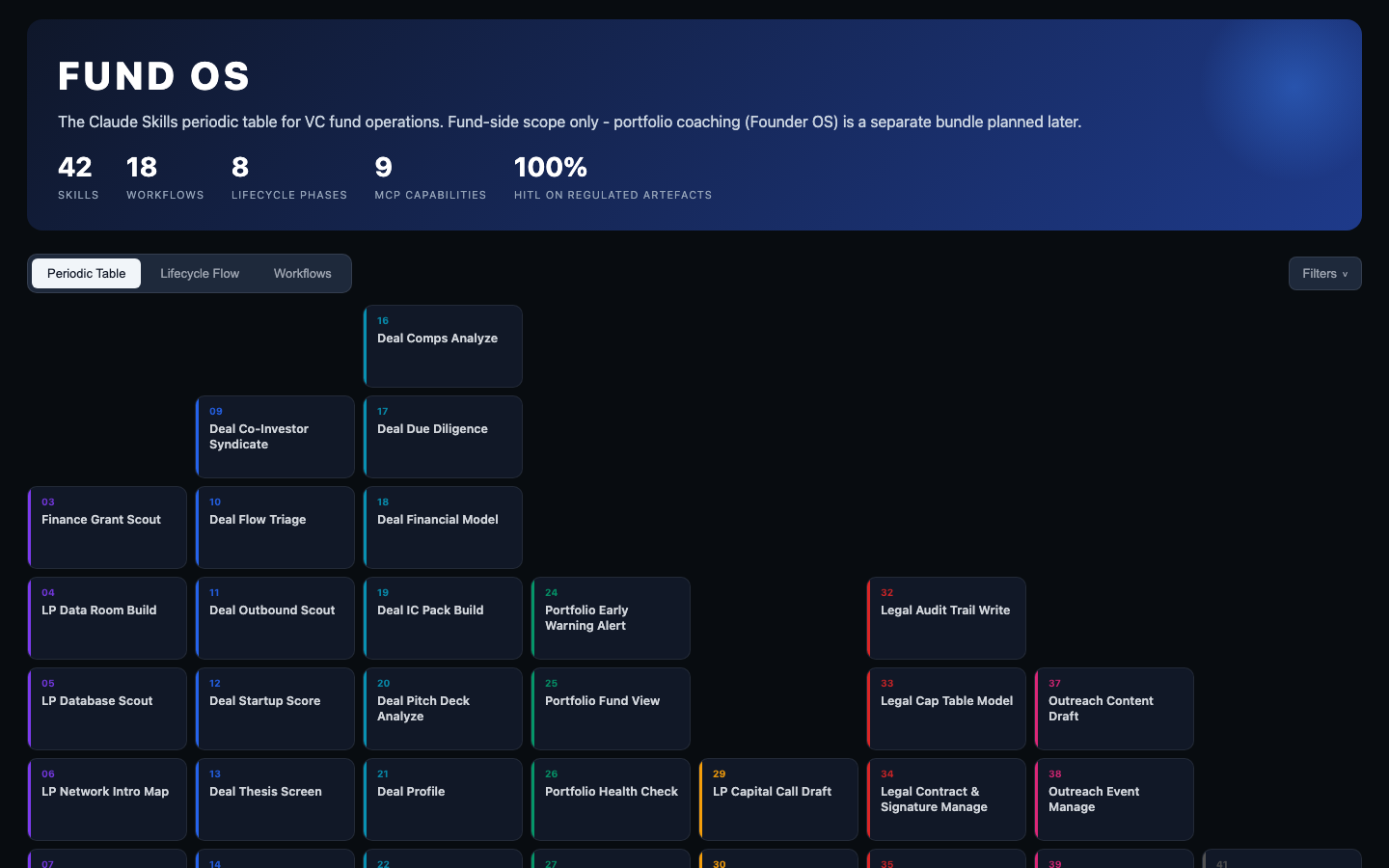
42 AI skills across 8 lifecycle phases , click to explore
We started our fund with a thesis that had nothing to do with deals.
What if we launch a fund agentic-first? AI runs the operational machine from day one. Our time stays where it belongs: people, relationships, and the water. Nobody ever found an edge formatting a quarterly report.
Why
Three reasons.
The founders we back never sleep. They compress decades into years. They outwork incumbents ten times their size. So why should fund managers operate at last decade's pace? A fund that moves slower than its own portfolio shouldn't lecture founders about execution.
The technology is ready. This is the most exciting time in a generation to start a company, because AI is finally mature enough for agentic operations. Models read pitch decks. They work across your CRM, your drive, your meeting notes. They follow your methodology and hand back finished work. If that makes it the best time to found a company, it makes it the best time to found a fund.
Nobody has built the bridge. The "AI-first fund" advice out there is written by engineers, for engineers. API keys, vector databases, custom pipelines. A two-person fund can't cook from that recipe. That gap is the opportunity.
We closed it as a side project, alongside running the fund. We got it wrong twice first.
What we learned the hard way
Attempt one: OpenClaw, the viral open-source agent. Thrilling demos. Then a researcher nearly lost her inbox to it. No audit trail, no human approval, full access to fund data. For a regulated fund, that's a liability with a chat interface. Lesson: accountability beats autonomy.
Attempt two: multi-agent workflows on Langdock, an EU agent platform. Documents crashed mid-workflow. Pricing pivoted to token rationing. Everything we built was locked inside one vendor. Lesson: reliability beats features, and portability beats both.
One insight survived both failures: your methodology is the asset, not your software. So we made the methodology the product.
What Fund OS is
Fund OS is not a tool. It's an operating system for a fund: covering the entire value chain, end to end.
Eight phases, from first euro raised to last euro returned:
- Fundraising & LP: scout LPs, map warm intros, draft outreach, build the data room, manage the pipeline through KYC
- Sourcing & Market Watch: outbound scouting, inbound triage, thesis screening, market intelligence, co-investor sharing
- Due Diligence: deck analysis, market maps, financial models, comps, reference checks, memos, the full IC pack
- Portfolio Monitoring: KPI collection, health checks, fund view, early warnings, variance analysis
- Reporting & Impact: capital calls, impact assessments, quarterly LP reports
- Legal & Compliance: document drafting, cap tables, contract management, regulatory deadlines, audit trail
- Ecosystem & Outreach: LP newsletter, public content, events, partnerships
- Exit & Wind-Down: exit scenario models, secondary market scans
The units inside are skills: short, plain-text playbooks. Each one points AI at one fund task and defines how it must be done. What a good memo looks like here. How we score deals. Exactly when a human must approve. The AI brings the capability. The skill brings the methodology. Open standards (MCP) connect both to the tools you already use.
No code. Anywhere.
And we didn't start from zero. Fund OS is built on open standards, Claude's Agent Skills format and MCP, and on VC-Skills.md, the open community knowledge base of 375 VC skills curated by Luis Schmitz. Where the community has better methodology, our skills reference it instead of rebuilding it. Standing on public foundations is the point: the open layer keeps improving, and our fund-specific layer rides on top.
42 skills compose into 18 workflows: the rhythms a fund actually lives by: the weekly deal digest, the monthly health check, the quarterly LP report, the capital call. One trigger runs a whole chain. The DD kickoff alone chains six skills, from deck analysis to IC briefing.
It's also a second brain: Karpathy's idea, minus the part where it dies. Most second brains end as wikis nobody maintains. Ours has no wiki. The CRM remembers every founder. The notes remember every meeting. The drive remembers every memo. The skills teach the AI to read across all of it. When a deal resurfaces after eight months, the system already knows the history. The knowledge grows as a by-product of the work. Not as a second job.
The magic isn't the AI. It isn't the human. It's the loop between them. The AI brings total recall and first drafts. The human brings what no model has: pattern recognition from lived deals, a read on a founder across the table, conviction. Every cycle sharpens both.
How a week looks
Monday, 9am. The deal digest is waiting. Outbound scouting, inbound triage, thesis screening, fresh market intel. Six hours of work, reviewed in thirty minutes.
A deal gets serious. One trigger starts the pipeline: deck scored on ten dimensions, market map, reference plan, first-draft memo in our template. A day of writing becomes thirty minutes of editing. The thinking stays ours. The typing doesn't.
An LP shows interest. The system builds the profile, maps the warmest intro path through our network, and drafts the follow-up calibrated to their thesis fit. The data room stays current automatically. The pipeline tracks every prospect from first call through KYC: no commitment slips through a forgotten follow-up. Fundraising stops being a spreadsheet and becomes a rhythm.
And the phases we haven't reached yet are already waiting. We're a young fund: raising now, first deals in diligence. But the system ahead of us is built: monthly KPIs collected and normalised, early warnings when runway shrinks, the quarterly LP report assembling itself for sign-off in thirty minutes instead of two days. We grow into our own operating system instead of scrambling to build it when the first reporting deadline hits.
Always. Every regulated artefact stops for human approval. Every action writes to an append-only audit trail. The fund admin platform stays read-only, forever. Compliance isn't a setting. It's a property of every skill.
How hard is the setup?
Install: minutes. One plugin file, added to Claude Desktop like an email attachment.
Customise: an afternoon. A built-in wizard walks through your thesis, templates, tools, storage. Standard connectors link your existing systems.
Updates: one command. Your customisations stay untouched.
We are two people with no developers. If we can run this, any fund can.
What changes
The old answer to fund operations was headcount. The new answer is depth per person. Two people now run sourcing, diligence, monitoring, reporting and compliance at the rhythm of a much larger firm.
For LPs: a structurally lower cost base, a regulator-grade audit trail from day one, and a team whose calendar finally matches its pitch.
Where this goes
Fund OS is public. It sits at github.com/steffenmaas/fund-os under the PolyForm Noncommercial licence: free for emerging managers, family offices, non-profits and education. What stays ours is the configuration on top, our thesis, our templates, our decisions. Every fund that adopts the methodology makes the shared skill library better. That's how a network of small funds out-executes the big ones.
Two more chapters are in development.
Founder OS brings the same architecture to the startups we back: validation, market research, GTM, fundraising prep, investor reporting. Portfolio reporting skills speak natively to fund monitoring skills. No more PDF ping-pong, one shared operating system. Founders don't just get capital. They get execution speed.
Operator OS takes it to the maritime industry itself: charter brokers, crew agencies, marina and fleet managers, businesses running six-figure operations over phone calls and spreadsheets today.
One architecture, three layers. The fund, its portfolio, and the industry they both serve.
About Ocean One Ventures
Ocean One Ventures is a pre-seed and seed stage fund and accelerator investing in software-first startups digitising the €130B leisure marine industry: from charter and marina management to fleet intelligence and crew operations. The company invests into maritime category leaders and champions of tomorrow, in places where software replaces friction, unlocks margins, and becomes mission-critical infrastructure, with ticket sizes of €100K to €500K.
The company operates like a tech company: AI-powered deal sourcing, proprietary portfolio intelligence, and a network built directly inside the marinas, fleets, and maritime operators where deal flow originates. Fund OS is the operating system behind that claim.
Fund OS is built on open standards, Claude Skills (Agent Skills format) and MCP (Model Context Protocol), and integrates the open VC-Skills.md community knowledge base (375 VC skills, curated by Luis Schmitz). Skill inventory, workflow definitions and KPI targets from the Fund OS Implementation Concept, v1.7, June 2026.
Run it at your own fund
Fund OS is public under the PolyForm Noncommercial licence: free for emerging managers, family offices, non-profits and education.