Our vision is to make the ocean accessible to more people. Our mission is to drive innovation in the yachting industry.
Most writing about innovation in yachting starts with today's industry and asks what to fix. This paper starts at the other end. It asks what the industry would look like if we built it today, with the technology, materials and business models that already exist, and with the customer as the measure of every decision.
The answer is a picture of where the industry can go, from the first sketch of a hull to the day the boat is recycled. We tell it through one owner who shares her yacht with others. Through her, both customers of the industry appear: the owner, who holds the boat, and the people who use it. And we look at three very different ways of being on a boat: steering yourself, sailing with a skipper, and being looked after by a full crew.
If we built yachting today, we would build it around the customer, on one shared record of every boat.
The vision: Yachting 2.0
Imagine an industry in which a yacht is designed around its owner, built with a record that follows it for life, used as easily as a hotel room is booked, and serviced before anything breaks.
The yachting industry grew over more than a hundred years. Builders, dealers, brokers, marinas, charter companies, service firms and insurers each developed their own way of working. Each works well on its own. The customer sits in the gaps between them, and passes the same information from one to the next.
Yachting 2.0 closes those gaps. No single platform or company can do that alone. It is a way of working that every participant can adopt: the boat carries its own data, the customer keeps one relationship, and the participants pass on information instead of asking for it again.
What stays: the sea and the reason people go to it, craftsmanship, the skipper and the crew, discretion, and a person who knows the client. What changes: how boats are designed and built, how customers find, buy, share and use them, how costs, condition and value are known, and how energy is used and boats end their life.
Why now
The parts exist, and five drivers come together:
- Technology is ready. Camera-based systems dock a boat on their own, and satellite internet connects more than 150,000 vessels.
- New models work. The largest boat club has more than 63,000 members, keeps about 90 percent of them a year, and 45 percent never owned a boat.
- Data opens up. The EU Data Act gives users access to the data their connected products generate. Products placed on the market from 12 September 2026 must offer it by design, and ships are named.
- Passports arrive. From 18 February 2027, industrial batteries above 2 kWh, boat traction batteries included, need a digital battery passport.
- Customers expect it. 83 percent of new cars sold worldwide in 2025 were connected at the factory.
Ten megatrends, rethought for yachting
Ten megatrends are changing what people expect, in banking, travel, cars and at home. Each of them is already normal somewhere else. Here is what each one means on the water.
Recognised everywhere
The boat, the crew and the marina know the client's preferences and history, shared with consent.
Decide from anywhere
Owners view, inspect and approve from wherever they are. Technicians are guided from a distance.
Use without owning
Charter, club or share give access without the full boat all year.
Made for me
The owner describes how she will live on the boat, and layout, glass and systems are computed for her.
Real-time information
Condition, costs, bookings and location are visible at any time, from a digital twin.
Clear prices, direct access
The final price up front and open availability, for the customer and for the AI assistant.
It has to pay off
Less cash out, income from charter and a residual value that is visible at any time.
The boat takes care of itself
Connected, it docks with help, watches the anchor and reports what is due.
Excellent service, around the clock
A person who knows the client, backed by systems that answer at any hour and in any language.
Good conscience on the water
Quiet, clean, and with proof of the footprint at the push of a button.
Yachting 2.0 keeps what makes yachting special and changes how it is delivered. The customer feels one industry instead of a dozen suppliers.
Lena and three classes of being on a boat
Lena runs a company in Munich. She orders a 16-metre electric hybrid catamaran with a glass deckhouse, based on the Côte d'Azur, and uses it about eight weeks a year. The rest of the year the boat is chartered to guests, among them the Moreau family from Lyon, who started in a boat club without ever owning a boat.
The industry knows three classes: self-drive, with skipper and fully crewed. For large yachts they stay different worlds. For a boat like Lena's, the class becomes a choice for each trip.
- Typical boat today
- About 12 to 24 m
- What the owner chooses
- A captain on demand, on board or remote, for a passage or a week
- What the boat and the crew do
- Robots take the routine. The captain looks after the guests, the sea and the machines.
Ten stations, five domains
The journey crosses the five domains of the industry: build, sell, own and operate, destination and service. At each of the ten stations the paper shows today's moment, the same moment switched on, and the moment that makes the owner say wow.
The journey · ten stations
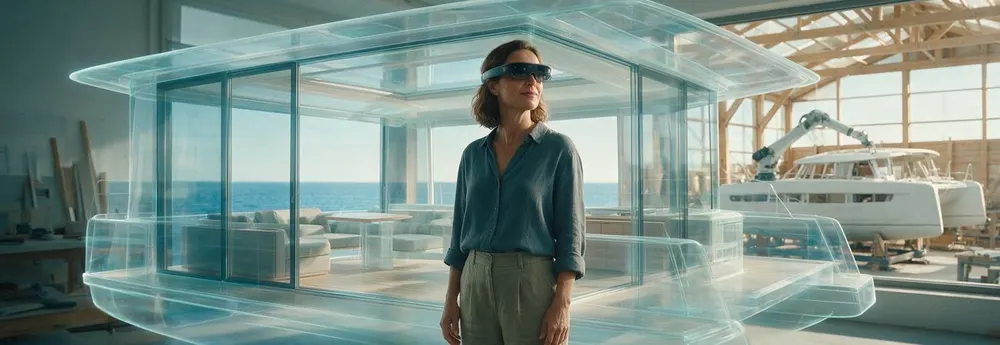
Lena describes how she will use the boat and walks through three layouts in virtual reality, each with a price and a date. During the build she moves a window by twenty centimetres with one tap.
“I stood in my saloon before the hull existed.”
"The buyer trusted the record more than my word. We agreed on the price in one call." Lena, at station ten
At every station the same three things make the difference: a record that follows the boat, one contact who knows the owner, and a hybrid crew of people and machines.
The yacht itself
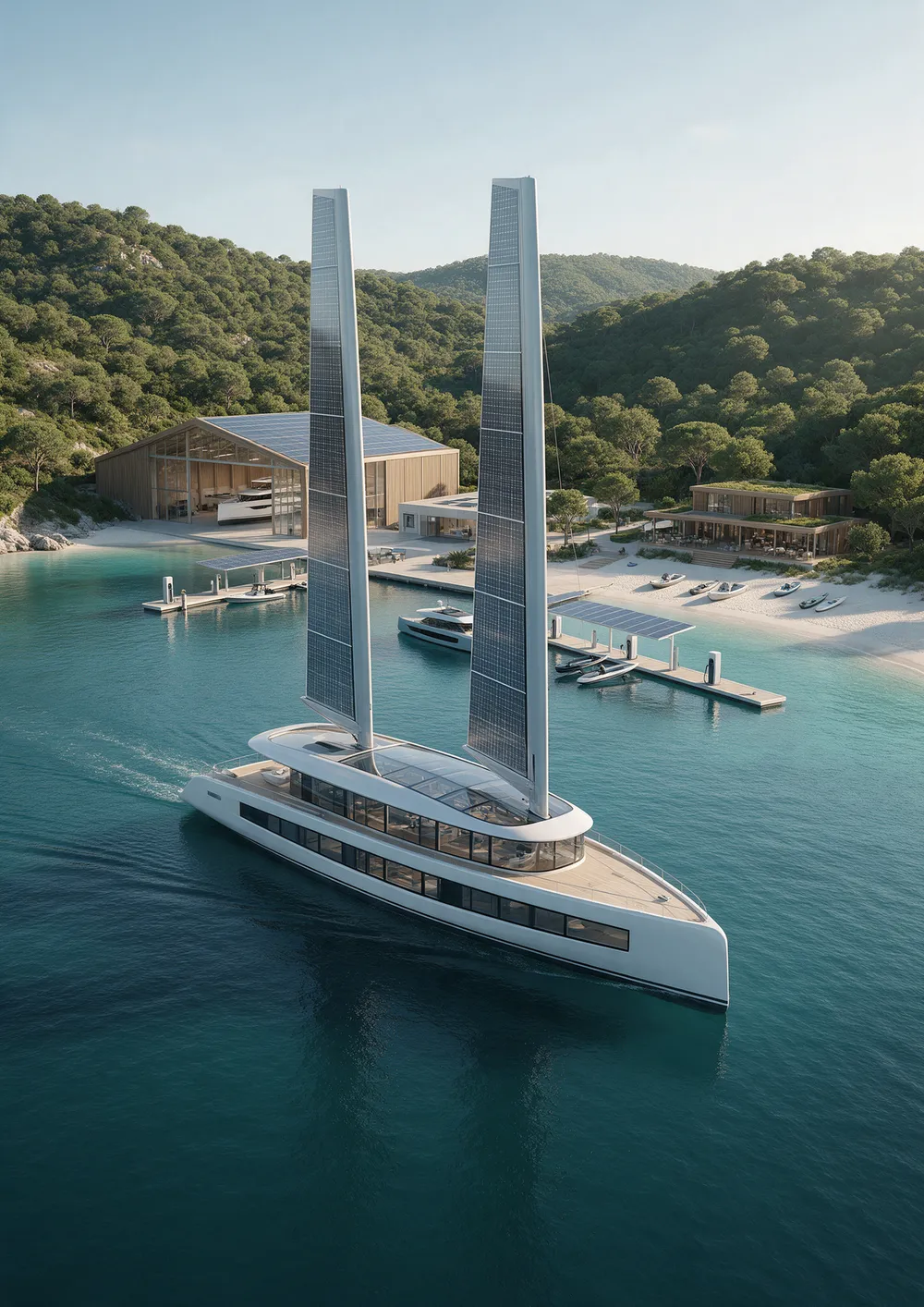
Software changes how a yacht is bought and run. Hardware changes how it feels. In Yachting 2.0 both are designed together, around the people on board. Tap a point on the boat.
The yacht itself
The boat opens to the sea: glazed sides, a glass deckhouse, panes that switch between clear and opaque, a roof that slides open above the saloon.
The best hardware in Yachting 2.0 is the one the customer notices least: the boat that flies quietly, stays level, listens, makes its own water and power, and reports its own needs.
The data world
Every station depends on data that moves with the boat and the customer. Today it stops at every door. Every boat gets a digital twin that knows its build, service, usage, condition and value. The customer gets one too, with preferences and documents shared with consent.
One twin helps one owner. Shared standards help every customer: book once, enter data once, hand over without loss, switch freely. In yachting it takes four building blocks: one ID for every boat, one twin owned by the owner, open data on board, and one format for listings and bookings. Discretion is part of the design: the owner decides what a buyer, an insurer or a service partner sees.
What it means for each market participant
Every participant has a role in Yachting 2.0, and none is replaced. Yards can open a digital record for every new hull. Engine and electronics makers can offer data access by design. Dealers and brokers can publish listings in a shared format that AI assistants read. Charter operators can open availability data, and marinas can offer online berth booking and one profile across the network. Insurers can price the real boat from verified records, and associations can host a working group on boat ID and booking formats.
For startups, the advice is to solve one station end to end and then connect to the next. For investors: back companies that build on shared standards rather than closed systems. The first movers set the standard. Those who open their data and interfaces early become the hubs others connect to.
How we get there, and beyond
Much of Yachting 2.0 can start today, in three steps, beginning where customers feel the difference first. Open and visible: final prices and total cost with every offer, one contact for every customer, owner data accessible under the Data Act. Connected and shared: every new boat recorded from the build, shared formats for bookings and listings, marinas as service hubs. Reinvented: boats designed for one owner at series cost, a small crew augmented by AI and robots, recycling designed in.
Yachting has always been about living well in a place that was not made for people. A yacht has to make its own energy and water, repair itself far from help and keep a small group happy in a small space. That is why some of the boldest ideas for how we will travel and live, from floating villages to the Moon and Mars, start on the water. The drone that brings a spare part to a yacht today is the first supply flight of tomorrow.
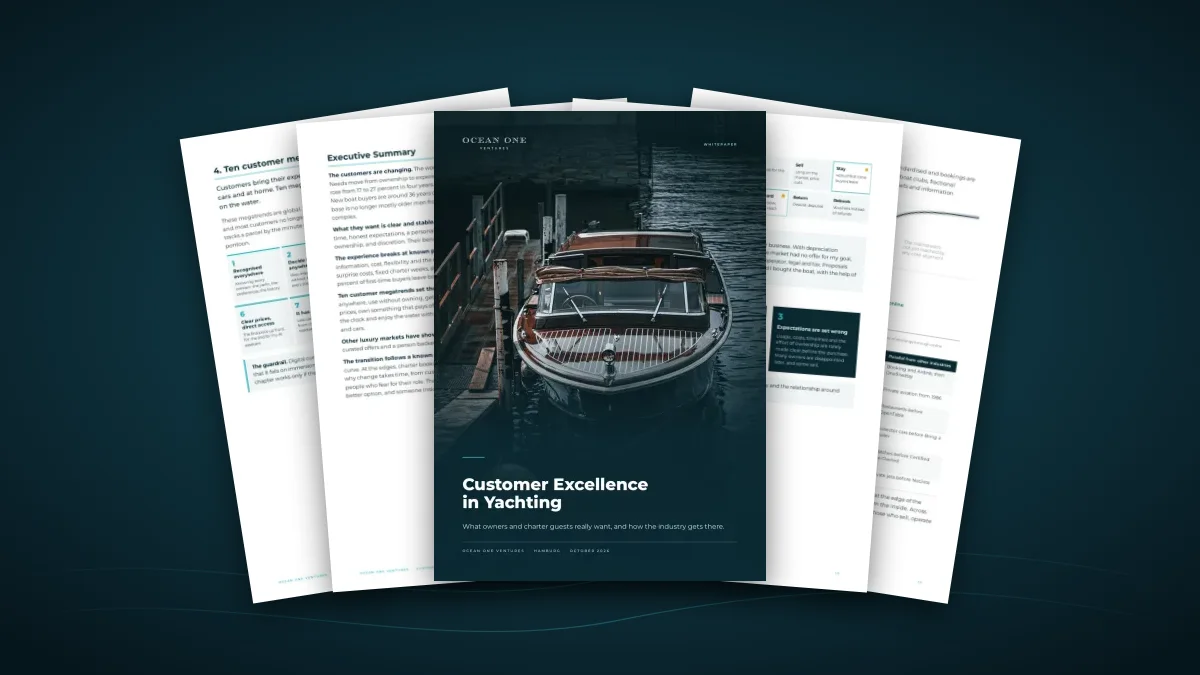
Let's charter a bright future. The full whitepaper covers all ten stations in detail, the hardware and the data world, and a first step for every market participant. Download it below, and then tell us where we are right and where we are wrong.