
Yachts: The Most Sustainable, Tax-Efficient Asset Class for Founders and Investors
Why a sailing yacht might be one of the smartest and greenest things to do with capital after an exit, and what several months of research, one Bavaria Voyager 45, and a deliberately honest financial model taught me about it.
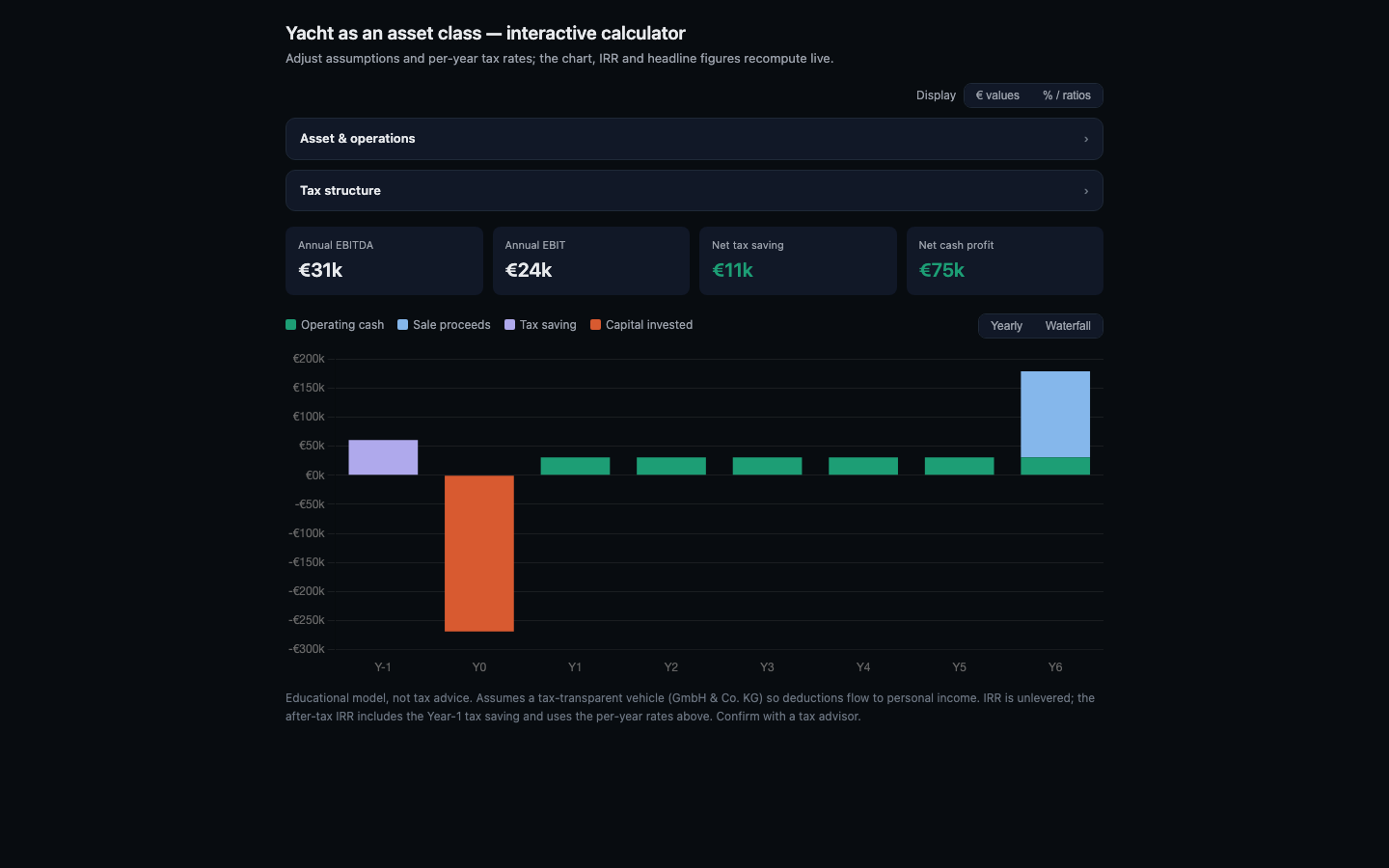
Cash flow, tax & IRR calculator , adjust assumptions and watch the numbers recompute live
Three things make this asset class worth a serious look, and they reinforce each other.
It is one of the most sustainable investments I know. There is no better way to give people a great time, with real holidays and real memories, while leaving so little mark on the planet. A sailing yacht travels on the wind, makes its own fresh water from the sea, and generates its own electricity from the sun.
It brings the shared economy to yachting. A boat owned by one person sits idle most of the year. Run as a charter asset, the same hull gives dozens of families their week on the water. It democratises access to an experience that used to belong to the few, and it puts the asset to work instead of letting it depreciate at the dock.
It is tax-efficient. Structured correctly, a chartered yacht goes beyond cash-positive: for the right owner it can turn a portion of an exit-year tax bill into a productive, enjoyable asset. More on that below, with the numbers.
1. First, it has to be a real, cash-positive asset
Built on real seasonal charter rates, not a single blended average, the operating economics are healthy. As occupancy climbs from roughly 18 toward 22 charter weeks, the EBITDA margin moves from about 44% to 53% of net revenue, a margin most operating businesses would envy, alongside a cash yield rising from about 8% to roughly 12% on the asset's value. It comfortably covers its berth, insurance, winter storage, maintenance and management commission, and still distributes cash.
That cash engine sits inside a structurally growing market. European leisure-marine is a multi-billion-euro sector riding a durable demographic and post-pandemic tailwind, and in peak weeks charter capacity is booked out months in advance. The honest framing of the return: over a typical hold including the eventual sale, the unlevered pre-tax IRR sits in the mid-single-digits (about 5%), with the bulk of invested capital returned at exit. A charter yacht is a cash-yield asset with a strong income margin and a tangible, re-saleable underlying. It is not a high-IRR growth play, and any pitch that implies otherwise deserves suspicion. That is the floor. The tax structure is where the return profile gets interesting.
2. The tax structure, and why founders should look twice
Held through the right vehicle and operated as a real charter business, a yacht unlocks three instruments most retail "programs" never mention: VAT recovery on acquisition, ordinary depreciation as a non-cash deduction, and the Investitionsabzugsbetrag (§7g EStG), which allows a deduction of up to half the asset's cost before it is even purchased.
The German IAB is the lever, and intellectual honesty matters here: it defers tax; it does not remove it. The upfront deduction reduces the asset's depreciation base, so the write-off shrinks over the hold and the eventual sale is taxed as a gain, repaying the benefit later. Across a flat tax life, it nets to roughly nothing. It moves tax through time without erasing it.
But a founder's tax life is rarely flat, and that is the whole point. In the year of an exit, income is taxed at the top marginal rate of around 45%. In the quieter years that follow, the rate is materially lower, perhaps around 25%. The IAB turns that asymmetry into rate arbitrage on one's own income: take the large deduction in the high-rate exit year, and repay it across the low-rate years that follow. A pre-tax IRR of about 5% moves to about 8% after tax. Of course this is a conversation to have with a tax adviser before signing, well ahead of any purchase.
Use the interactive calculator above to adjust price, occupancy, holding period and per-year tax rates, and watch the IRR, EBITDA and tax figures recompute live.
3. You actually have to make money, and the tax authority is watching
None of the above survives unless the venture is, demonstrably, a real business. German tax authorities only honour these deductions if the enterprise turns a profit over its entire life: the total gain, summed across every year of operation plus the eventual sale. A clear total profit means a genuine business and the deductions stand. A pattern of permanent losses with no credible path to profit invites reclassification as a hobby (Liebhaberei), and the benefits are withdrawn.
This should be read as a feature, not a loophole, and it is worth stating in the plainest terms: the objective is to operate a profitable charter business and pay the tax that profit properly attracts. The tax structure governs the timing of that liability across years; it does not manufacture losses or conjure a benefit from thin air. On conservative occupancy and a realistic resale, the venture shows a solid cumulative profit over the hold. It is meant to.
Making sure it stays that way is an operating discipline. Charter the boat enough weeks to run a real profit, keep clean books, document commercial intent from the outset, and adopt a depreciation period that can actually be defended. Budget conservatively, prove the profit, pay the tax it earns, and the structure is sound. That places the entire case on three operating questions: the right boat, the right charter partner, and sufficient occupancy.
4. Finding the right boat: treat it like buying a house
There is a structural problem nobody flags upfront: the charter-yacht market has no public benchmark. Unlike equities, or even used cars, there is no price index, no yield data by model, no transparent view of what a given boat actually earns or what a fair charter rate looks like in one cruising region versus another.
The closest analogy is buying into an unfamiliar property market. No serious investor buys their first building in a new city on the strength of a single broker's pitch. They spend time understanding comparables, yields by location, and what drives price, or they work with someone who already has. A yacht is the same: the edge comes from understanding the market before transacting, and that understanding takes real time to build.
To close that gap, a proprietary toolset emerged from this project: a structured dataset and analysis layer covering the relevant boat segment and cruising region, used to judge whether a given asset is fairly priced and how it should perform. That capability is part of what makes the difference between buying well and overpaying, and it can be made available on request.
Two principles do most of the work. New and common boats vs. used and rare: a new boat on a high-volume platform brings full warranty, a clean cost base for the tax structure, broad parts and service availability, and predictable resale. In charter, ubiquity is a feature. And timing matters: the most attractive window to buy is at the start and especially the end of the season, when fleets rotate out hulls to make room for new models, a window that opens briefly and closes fast.
5. Finding the right cruising region, and the right charter company
Before the operator comes the cruising region, because geography sets the ceiling on both income and asset quality. The decisive variables are season length and weather risk. The Mediterranean is the benchmark on the upside: a long charter season, often running well beyond the northern European window, means more billable weeks per year and a higher revenue ceiling from the same hull. The Baltic trades a shorter season for strong, event-driven peak demand and proximity to a wealthy charter base.
The cautionary case is the US market, where intense storm and hurricane exposure does real damage. Boats in storm-prone waters age faster, accumulate weather-related wear, and, when they come to market, often sell at a discount, with visibly harder-used hulls and disappointed owners behind them. Region, in other words, drives not only how many weeks the boat earns but how well it holds its value to exit. The right region maximises season length while minimising the weather risk that quietly erodes resale.
With the region chosen, the operator is the next decision, and a strong boat with a weak operator is the fastest way to erode the return. The management agreement reveals far more than the marketing does. The terms that matter most:
- A real marketing and booking engine (trade presence, an active pipeline) rather than a passive listing on a portal.
- Transparent, sensible commission. A roughly 30% gross fee is the regional norm; the share is materially lower on bookings sourced directly.
- Settlement terms that respect cash flow, meaning periodic payout rather than a single reconciliation at season's end.
- Owner-use rights. Some agreements exclude owner use entirely; a workable structure preserves at least a few weeks a year.
The operator should be chosen on quality, not price. They are the single largest swing factor between mediocre and strong occupancy, and they warrant the scrutiny one would apply to a key hire.
6. Optimising the asset: the levers that move the return
Once the boat is in the water, occupancy and margin determine everything, and a few levers do most of the work of turning a break-even asset into a profitable one.
Owning the demand channel. Broker commission is the largest single cost; bookings sourced directly carry a far lower fee, so every self-originated week flows straight to the bottom line. This is also why occupancy should never be left entirely to one operator's portal. In my case I created a mobile-first, multi-language booking presence to reach Baltic charter demand directly, visible at baltic-voyager.de.
Rethinking the user experience, not only owning the channel. Owning the demand channel is the start; the bigger opportunity is rethinking how charter is sold. Nobody actually wants to scroll through endless boat portals comparing hulls. People want a focused recommendation of an experience: a specific trip, a date, an event they can take their friends to, with the confidence that everything is already organised. The boat is the asset; the experience is the product.
Pricing the season rather than the average. Filling peak weeks first and pricing marquee event weeks at a premium lifts revenue without adding a single day on the water.
Adding skippered and premium weeks. These carry a meaningful surcharge, and a handful per season is enough to push the operating result firmly into profit.
The principle underneath all of these: a charter asset is only as good as its occupancy. Controlling the demand channel, and the experience on top of it, is what converts hope into a forecast.
7. At the end, there is a yacht waiting for you
It would be too clinical to stop at the numbers. The part no model captures: at the centre of this asset class is a sailing yacht which is a highly emotional asset for most people. With owner-use rights preserved in the management contract, the same asset that quietly earns its keep and works on the tax bill is also the one aboard which a family sails to Bornholm in August and ties up in a five-star marina at season's peak.
The open weeks are not idle weeks. Any time the boat is not chartered, it is simply yours: spend the time on it, take it out, and have a great time, powered by wind and sun. Few asset classes can be physically boarded, and for someone who loves the water the combination is rare: a tangible, cash-generating, tax-efficient, and sustainable holding that is also a real source of joy.
And it doesn't have to stop at one yacht. Once you understand the economics of a single boat, the same thinking scales to the whole industry: better charter operations, smarter insurance, cleaner interfaces to the customer, a far better customer experience, and more sustainable boating across the board. One well-run yacht is the proof point. The real prize is rethinking and improving the entire ecosystem around it.
This reflects independent experience and research, not tax or investment advice. Tax outcomes depend heavily on individual circumstances, marginal rates and legal structure, so professional advice should be taken before acting. Figures referenced are illustrative and drawn from a proprietary model; the full calculation is available on request.
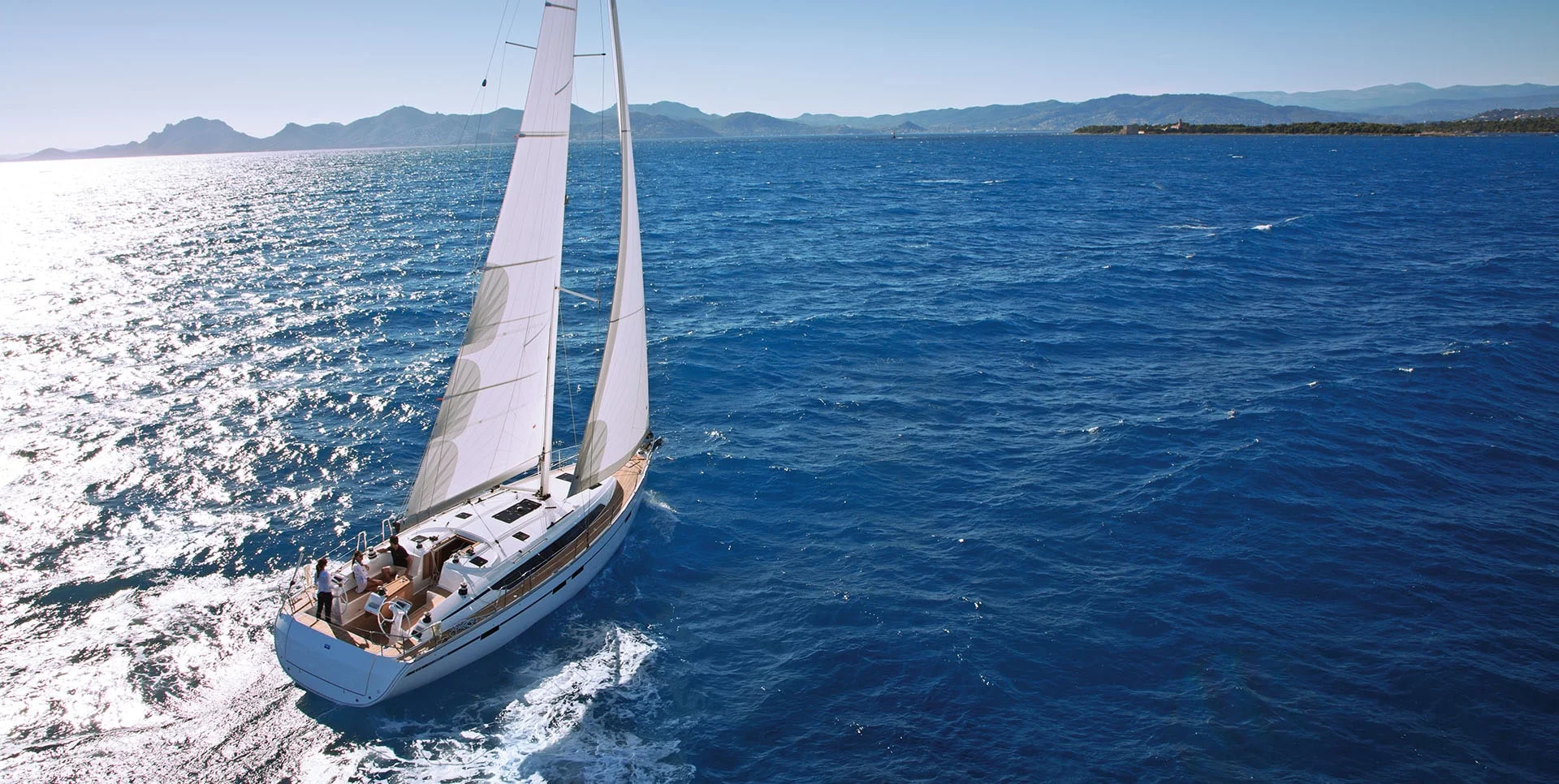
Book a charter week on the Baltic Sea
The Bavaria Voyager 45 is available for skippered and bareboat charter. Explore the Baltic, try the boat, and see the asset class from the water.
More from O1 Insights
The Industry That Selected Against Its Own Software
5 min read
$5.65 Billion Says Maritime Leisure Is Not a Niche
4 min read
Why Maritime Leisure Is Booming, And Why Most Investors Haven't Noticed Yet
5 min read
Accelerator Graduates Raise $1.8M More on Average. Most Founders Never Apply.
3 min read
Everyone Read the D-Marin Deal Wrong
4 min read
The Harbour Father and Son Read Differently
4 min read
The Next Wave of Blue Growth: What the EU's 2026 BlueInvest Report Means for Investors and Startups
8 min read
We Are the Ocean
6 min read